我连续两周追踪了自己的 Claude 使用情况。每一项任务都记录了时间戳、节省的时间与手动完成相比的对比。
每周 11.4 小时。这意味着每个月你能拿回 45+ 小时,也就是整整 2 天——只靠浏览器标签页里的 10 个 Workflows。
这里的 Workflow 指的是一个可重复的 Prompt + 结构,你每次做同类任务时都会用到。它是一个你反复运行的系统:相同的输入格式、相同的输出格式、结果可预测。
那为什么还要花 3 小时去做一件 10 分钟就能自动化完成的事呢?
以下是我这个月用过的所有 Workflows——按节省时间排序 👇
在开始之前, 我在 Telegram 频道分享关于 AI 和 vibe coding 的每日笔记:https://t.me/zodchixquant🧠

准备工作
在介绍 Workflows 之前,先说一下我在用什么:就是 Claude 网页版 + Pro 订阅。
没有 API。没有终端里的 Claude Code,也没有自定义集成。
1. 研究:一切的开端
今年 2 月,我需要为一篇文章对比 6 个 MCP server 提供商。
以前的方法:打开 15 个标签页,浏览文档,把引用的内容复制粘贴到 Google Doc,试着理解它们,发现忘了一个提供商,再开更多标签页,被 Twitter 分心,2 小时后回来,文档还是乱的,还得重新整理(Twitter 这部分我说得对吧?)
现在我上传我的 rules.md,然后输入:
Research [TOPIC].

Structure:
1. Executive summary (3 sentences max)
2. Key findings (top 5, ranked by impact)
3. What's missing: gaps in available info
4. Sources with URLs

If data is insufficient for any claim, say so.
Don't speculate. Don't pad.
让这个工作生效的关键一句是”If data is insufficient, say so.”。没有这句话,Claude 会自信地编造数据。
使用示例:
2. 内容研究:10 个来源,5 分钟提炼成一份简报
做内容时最耗时间的一直是在动笔之前处理所有信息。
一篇典型帖子需要阅读 5-10 个来源:GitHub READMEs、文档、Twitter 帖子、博客文章、更新日志。
手动阅读、高亮、交叉引用、提取真正重要的内容,以前每篇文章要花超过一个小时。
现在我把所有原始来源复制粘贴到 Claude,然后运行这个:
Here are my sources on [TOPIC]:
[PASTE ALL RAW MATERIAL]

Extract:
1. The 5 facts that matter most for my audience
 (builders, not consumers)
2. Anything that contradicts the common narrative
3. Specific numbers: stars, users, funding, benchmarks
4. One angle nobody else is covering

If two sources disagree, show me both sides.
Don't summarize fluff. Only signal.
3. GitHub Repo 分析:扫完 1000 个仓库不发疯
我的第一篇文章需要从 MAGI//ARCHIVE 扫描超过 1000 个仓库,挑选出 40 个值得介绍的。
手动做的话,每个仓库 3-5 分钟,总共需要 50+ 小时。
我改成导出仓库列表,批量喂给 Claude,然后运行这个:
Here's a list of GitHub repos with descriptions:
[PASTE BATCH]

For each repo, evaluate:
1. What it actually does (1 sentence, no marketing speak)
2. Traction signals: stars, recent commit activity,
 contributor count
3. Category: agent framework / dev tool / MCP /
 infrastructure / other
4. Worth featuring? Yes/No with one reason

Skip anything that's just a wrapper, a tutorial repo,
or has no commits in 30+ days.
Sort the "Yes" picks by most interesting first.
Claude 每次处理 50-100 个仓库。
我仍然会亲自打开每个”Yes”的仓库去核实,但只需要检查大约 80 个,而不是 1000 个。
节省最多时间的筛选条件是”跳过 30 天以上没有 commit 的仓库”。
Trending 列表上有一半热门的仓库其实已经被废弃了。
4. 不用电子表格做数据分析
说实话,从高中计算机课开始我就讨厌电子表格。
但我经常需要分析内容指标、交易表现、互动模式这些。
以前的方法:导出 CSV,打开 Google Sheets,花 40 分钟写公式,发现一个错了,全部重来。
现在我直接上传文件:
Analyze this data. I need:
1. Top 3 trends over time
2. Anything unusual or unexpected
3. Correlations between [COLUMN A] and [COLUMN B]

Table first, then a 2-paragraph summary explaining
what this means in plain English.
If the dataset is too small for a conclusion, say so.
5. 竞品分析
有时候偶然发现一个有趣的账号或项目,我以前会花一个小时翻完他们的内容、定位和受众。
现在我给 Claude 上下文,让它干活:
I'm analyzing [COMPETITOR/ACCOUNT].

Based on what you know + the data I'm providing:
1. Top 3 things they're doing well (be specific)
2. Gaps or weaknesses in their approach
3. What I can learn from them
4. How my positioning is different

About me: I write about AI tools, vibe coding, and
crypto for builders. TG + X.

Don't say "they have a strong brand." Tell me WHY
and what specifically makes it work.
关键是你要给 Claude 关于你自己的上下文,而不只是竞品的信息。否则你得到的是一份可以套用在任何人身上的通用 SWOT 分析。
6. 代码审查——发版之前
我经常 vibe code,用 AI 运行项目。意思是 Claude 写了大部分代码,我需要确认它不会出问题或者把 API keys 暴露给全世界。
Review this code for:
- Security issues (exposed keys, injection, XSS)
- Logic errors and edge cases I might have missed
- Performance problems
- Anything that would make a senior dev uncomfortable

For each issue: severity (Critical/High/Medium/Low),
exact location, why it matters, and the corrected code.

Be harsh. "Looks good overall" is not helpful.

[PASTE CODE]
“Be harsh”这个指令比你想象的更重要。
没有它,Claude 默认给出礼貌的反馈,比如”代码结构很好,也许可以考虑……”
有了它,你得到的是你真正需要的那种刻薄的代码审查者的能量。在刻薄这件事上,Claude 比你想象的在行多了。
7. 长内容 → 短内容(反向亦可)
如果你同时运营多个社交媒体账号(X、Telegram、Instagram 等等)。
你就知道在每个平台发同样的内容、同时为每个平台写不同的东西有多痛苦。
Here's my article: [PASTE OR UPLOAD]

Create:
1. A 2-sentence hook for X (include a specific
 number or claim from the article)
2. A 4-paragraph TG post with the key insight
3. A provocative quote-tweet caption (1 sentence)
4. 3 standalone insights that work as separate
 tweets throughout the week

Each piece must work independently. Someone who
never read the article should still get value.
我那篇 GitHub 热门仓库文章变成了:1 条 TG 公告、3 条分散在一周内的独立推文、2 条 quote-tweet 字幕,还有帖子开头。
一个 Prompt,10 分钟编辑。以前要 2 小时。
这个方法反向也适用,说实话这是我最好的一些内容的来源。我会把一周内的 5-6 条短 TG 帖子全部粘贴进去,让 Claude 找到贯穿其中的线索,起草一篇文章大纲。
只是个想法。
8. 不像机器人写的邮件
如果你的工作涉及写邮件,你懂那种感觉:花 15 分钟纠结一个 4 句话邮件的语气。太正式听起来像机器人,太随意听起来不专业。
这个 Workflow 解决这个问题:
Draft an email.
To: [NAME + how I know them]
Goal: [WHAT I WANT THEM TO DO]
Tone: professional but sounds like a real person
Max: 5 sentences
Context: [THE SITUATION]

Does not sound like: a cold pitch template,
corporate speak, or something ChatGPT would write.
No "I hope this email finds you well."
“does not sound like ChatGPT”这个指令是关键。没有它,你每次都会得到经典的 AI 邮件开头。
有了它,Claude 写出来的东西读起来像一个尊重收件人时间的大忙人。
9. 每日早间简报
每天早上,同样的流程。咖啡,打开 Claude,一个 Prompt:
3-minute briefing:
1. Top 3 AI news from last 24 hours (one sentence each)
2. Crypto: major moves, liquidations, new narratives
3. Anything I should know before posting content today

Be specific: names, numbers, links.
Skip anything that isn't genuinely important.
3 real updates > 10 filler items.
这取代了每天早上刷 45 分钟 X”来保持信息更新”。
刷信息流的问题是你看到的是新闻和 drama、表情包、互动诱饵、20 分钟的兔子洞混在一起。
Claude 给你信号,没有噪音。
它完美吗?不是。有时候它会漏掉东西,尤其是最近一小时内的突发新闻。但它能捕捉到 80% 重要的事情,而且我拿回了我的早晨。
剩下那 20% 我在一天中自然地从群聊和通知里也能看到。
10. 周回顾:投资回报率最高的 Workflow
每个周日晚上,我把一周里的所有东西都丢给 Claude。笔记、书签、半成品的想法、截图、存了但忘了的任何东西:
Here are my notes and ideas from this week:
[PASTE EVERYTHING]

Help me:
1. Find patterns: what topics am I gravitating toward?
2. Which 3 ideas have the most content potential?
3. What am I ignoring that I shouldn't be?
4. Content plan for next week: 3 TG posts + 1 article topic

Be honest. If an idea is weak, say so.
Don't tell me everything is great.
在这里 Claude 不再只是一个工具,开始变成一个思维伙伴。它能看到你自己的各种想法之间的联系,而因为你离自己的作品太近,这些联系你反而看不到。
周日 30 分钟。省下的是整个星期不知道该写什么的数小时。
这是我用 Claude 做的投资回报率最高的事。
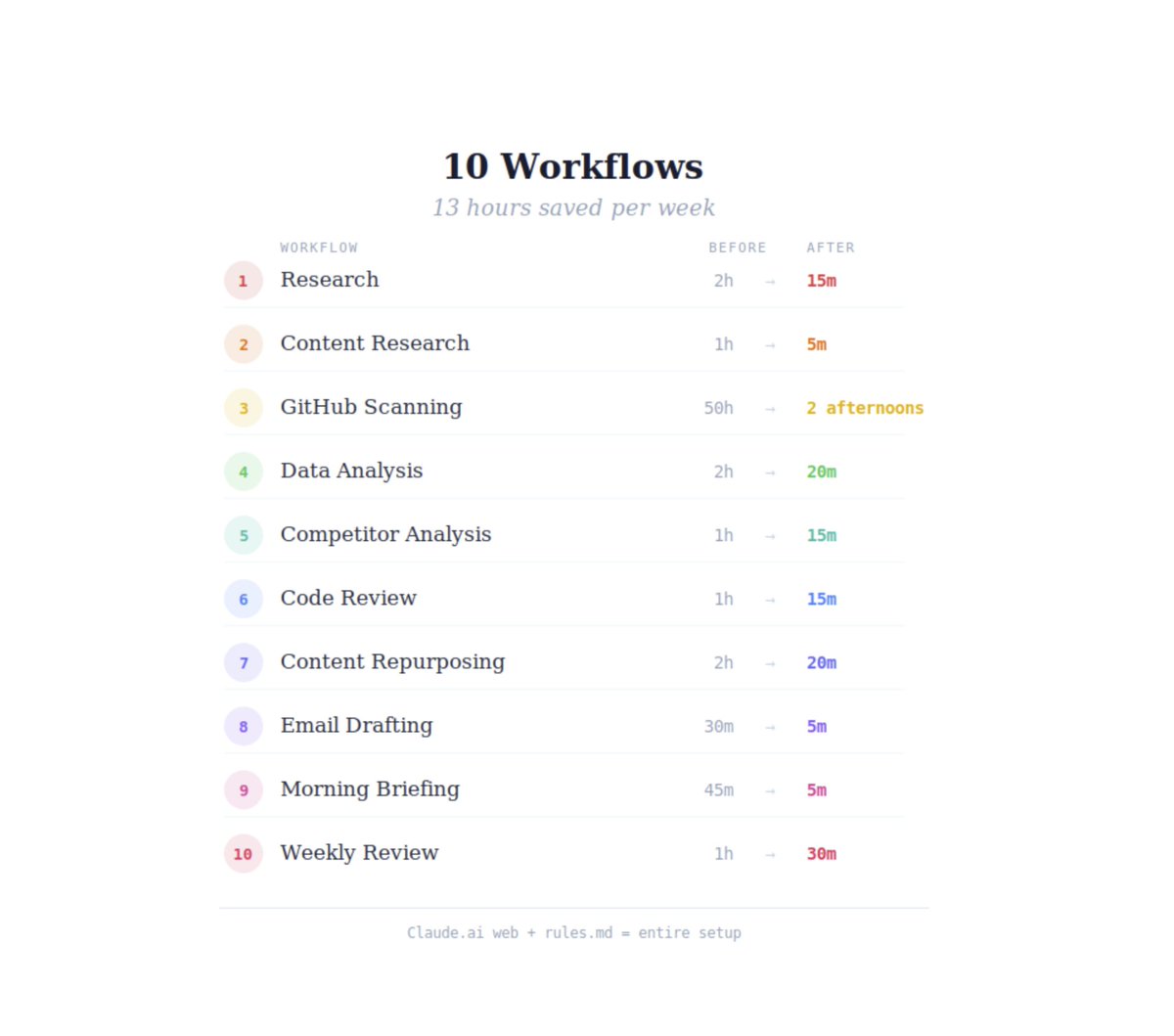
算笔账
以下是完整的分解。我追踪了两周然后取平均值:
Workflow Before After Saved/week
─────────────────────────────────────────────────────
Research 2 hrs 15 min 1 hr 45 min
Content Research 4 hrs 1.5 hrs 2 hrs 30 min
Github Repo Analysis 1.5 hrs 20 min 1 hr 10 min
Data analysis 2 hrs 20 min 1 hr 40 min
Competitor analysis 1 hr 15 min 45 min
Code review 2 hr 15 min 1 45 min
Content repurposing 2 hrs 20 min 1 hr 40 min
Email 30 min 5 min 25 min
Morning briefing 45 min 5 min 40 min
Weekly review 1 hr 30 min 30 min
─────────────────────────────────────────────────────
TOTAL ~13 hrs/week
每周 13 小时。每月 52 小时。这相当于每个月多拿回一整个工作周。
需要说明的是:这些数字是我的。你的情况取决于你做什么以及你当前工作流里有多少摩擦。
但即使你只采用其中的 3-4 个,你每周大概也能拿回 5+ 小时。这不是小数目。
真正改变了什么
从追踪这一切中我学到的最重要的事,不是关于 Claude 或 Prompting,而是我的时间实际上都去哪儿了。
我把大多数称为”工作”的东西,实际上是上下文切换。
打开标签页、重新阅读、被打断后重新进入状态、做那些感觉有产出但实际上没有推动任何事情前进的任务。
思考和编辑仍然是我的。关于写什么、交易什么、发布什么的决定。
但初稿、研究、整理格式、初步分析。这些东西现在几分钟就搞定,而不是几个小时,而且它让我腾出精力去专注那些真正需要人脑的部分。
说”AI 做不了我的工作”的人通常是对的。但 AI 大概能完成你工作中 60% 的周边事务。而那 60% 正是所有浪费时间的地方。
更多关于 AI、crypto 和 vibe coding 的笔记在我的 TG:https://t.me/zodchixquant 🧠
